


Mbare, Harare. On Tuesday, just a few minutes after five, the banks closed. A young man is leaning on the side of a kombi, with his thumb hovering over a broken Tecno screen. On it, a small red plane climbs. 1.4x. 1.8x. He waits.
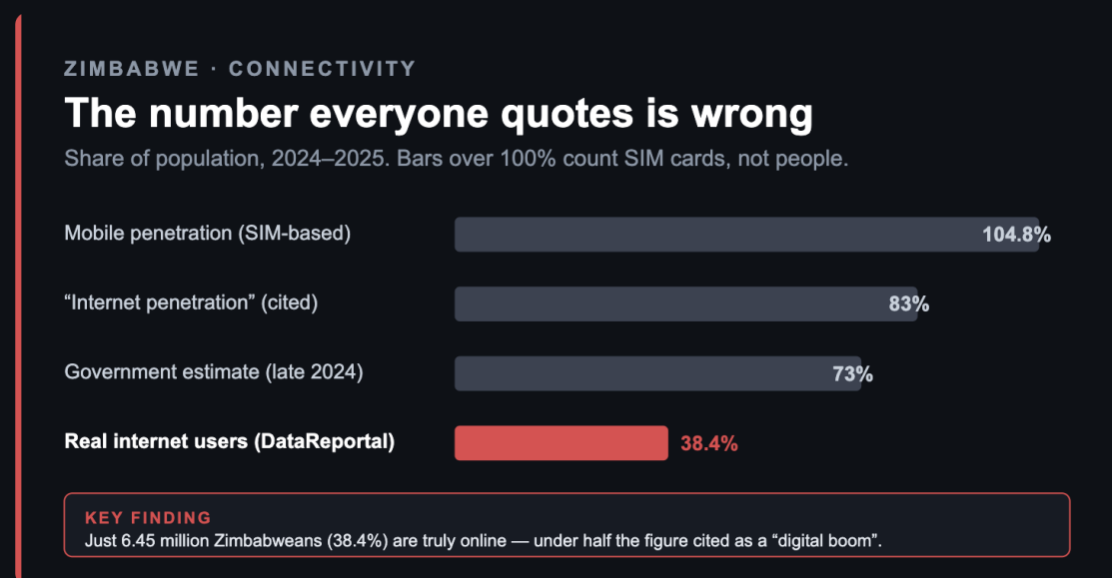
He’s not playing just for fun. The small amount of money in his EcoCash wallet is for his dinner. If you cash them out at the right time, they will double. If you leave it too long, they will disappear. That is the best, and a version of it runs across millions of phones every evening. This is strange because the official story of Zimbabwe’s gambling boom doesn’t mention hunger. It says one thing: 103% mobile, 83% online. A modern market that uses technology and is well-connected. Hold that second number. We will come back to it because it is wrong, and the correct one explains everything.
The Reserve Bank is counting the other end of that same phone all over the city. EcoCash now handles more than 70% of all payments made in the country. The money for the shopping and the bet is in one wallet. No one walks into a casino here. They were never asked to.

We went looking for the digital miracle story that everyone keeps talking about. We couldn’t find it. We found something colder.
How Many Zimbabweans Are Actually Online?
There are way fewer people than the press releases say. At the start of 2025, only 6.45 million people were regularly logging on. That’s 38.4% of the country, not the 83% you often hear about.
The problem is how those big numbers are calculated. They count SIM cards, not people. By the third quarter of 2025, more than 104.83% of people in Zimbabwe had a mobile phone, but the figure is still close to 100% because many people have more than one SIM card. This is to avoid areas with no signal and to take advantage of cheaper deals. Even the government’s own estimate is around 73%, which is well above the number of people who actually log on. DataReportal’s 38.4% figure measures real users. So the idea that everyone’s talking about, that there’s this amazing connectivity, starts to look a bit shaky here. The boom isn’t about how many people are online. It’s about which ones, and what’s pushing them there.
Why Are So Many Zimbabweans Betting Online?
For many of them, it’s not just a hobby. It’s just a paycheck.

We sat down to write a story about opportunity. The research made us think differently. ‘Opportunity’ is too gentle a word for what is happening. It’s more like triage. In 2024, Martin Magidi and Tavengwa Gwekwerere tracked unemployed men aged 18 to 38 in Harare and the nearby town of Norton. Their paper, which has been reviewed by other experts in the same field, says that betting is part of a survival culture and a way to make money while waiting for a real job. A GeoPoll survey in six African markets that same year found that 76% had gambled, most of them young men. And by 2024, more than 300,000 Zimbabweans were betting online regularly.
When prices are going up, and there are only informal jobs available, owning a phone might be the only thing you can do to make money. That’s the engine. Not 5G.
How Do You Deposit at an Online Casino in Zimbabwe?
You can use the same phone wallet as you do for everything else—first, EcoCash, then OneMoney, Telecash, and more and more crypto.
This part of a pitch deck is rarely discussed, but it is the most important. EcoCash is the most popular mobile money service in Zimbabwe, making up about 86% of the market. This information comes from the Reserve Bank of Zimbabwe’s 2025 figures. You don’t need a card, a bank account, or a minimum balance. For people who don’t have a bank account, the difference between their regular money and the money they use for betting was eliminated. Bitcoin and USDT give younger players a second option, one that avoids currency controls and is less obvious. It’s as easy as that: put money in, tap, and it’s ready to go. The casino is in the wallet.
What Is Zimbabwe’s New 2026 Gambling Tax?
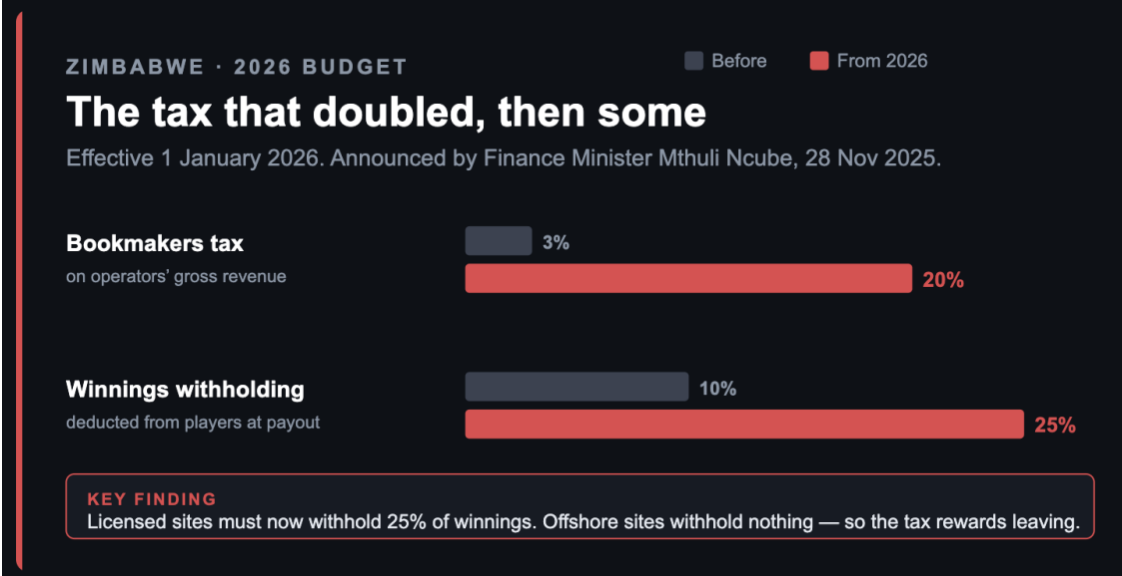
From 1 January 2026, operators will pay 20% of gross gaming revenue, up from 3%. Players now lose 25% of their winnings to a tax, up from 10% which is taken from their payout and sent to ZIMRA.
On 28 November 2025, the Finance Minister, Mthuli Ncube, announced this in the 2026 National Budget. He was honest about why. He told Parliament that the growth had led to addiction, debt, suicide, and loss of productivity, which was more than the rules could contain. The human cost is not just a small part of the reason for the policy – it is the main reason. The operator levy is now a final tax, so betting firms no longer pay corporate income tax, and all filings are made through ZIMRA’s digital TaRMS system. For example, in 2023, the sector produced about US$120 million, with online play making around US$45 million, according to The Herald.
Will the 25% Winnings Tax Push Players Offshore?
Most likely yes. This is the contradiction at the heart of the policy.
Think about it as a player would. The 25% fee only applies to a licensed platform that doesn’t actually pay out. Offshore sites, which ZIMRA doesn’t control, do not. A man has every reason to leave. He has a smartphone, an EcoCash-to-crypto path, and a fresh complaint about losing a quarter of his winnings.
Try your luck fishing offshore. The full payout is for offshore work. The regulated option costs more than the unregulated one, so it’s better to use the offshore option. You can feel where this is going.
The minister is right about the numbers. If you tax a successful sector, you raise money. He’s right about money, but wrong about how he behaves. These are not the same problem. Only players who follow the rules have to pay tax. This makes it easier for people to buy things from other countries. The state has created this advantage itself. The policy created to capitalize on current growth may actually make it worse by increasing exports.
What Games Are Zimbabweans Playing?
Sports betting is still the most popular, but casino games are growing the fastest. These include games like Aviator, slots and live dealer tables, and most of these games are on platforms that operate in multiple countries.
Crash games are perfect for the moment because you make one decision and instantly see the result, which is exactly what a survival bettor wants. Beyond that sit the slots. Plenty of players reach across the border to South Africa-facing sites, where catalogues of Habanero games South Africa punters favour sit next to live blackjack and roulette. The same offshore pull the tax now sharpens is the pull toward these libraries: bigger selection, no withholding, one familiar wallet.
How We Got These Numbers
The connectivity figures come from DataReportal’s Digital 2025: Zimbabwe report from January 2025, which includes POTRAZ’s Q3 2025 sector data. The 2026 tax rates and the minister’s comments are based on the 2026 National Budget statement dated 28 November 2025, as reported by The Herald and iGamingToday. The survival-betting findings come from the Magidi and Gwekwerere study, which was reviewed by other scientists (Humanities and Social Sciences Communications, 2024). The information about mobile money was reported in 2025 and comes from the Reserve Bank of Zimbabwe.
ZIMRA will get its 25%. It will just collect it from the players who could not afford to leave.
FAQ
Is online gambling legal in Zimbabwe?
Yes. Licensed sports betting, lotteries, and casino operators are now legal and must pay tax under the 2026 Finance Act. Many residents also use offshore sites that sit outside that framework, which is exactly what the new tax may encourage.
What will the betting tax rate be in Zimbabwe in 2026?
From 1 January 2026, both operators and players will pay tax on gambling. Operators will pay 20% of the gross gaming revenue, and players will pay a 25% tax on winnings. Before that, the rates were 3% and 10%, respectively.
Do people in Zimbabwe have to pay tax on money they win from playing the casino?
On licensed platforms, yes. The operator keeps 25% of the gross winnings at the time of payout and sends it to ZIMRA. Offshore platforms do not usually withhold, which is the loophole that has led to more and more businesses moving offshore.
Can you use EcoCash at online casinos in Zimbabwe?
Yes, and most players do. EcoCash is used for most mobile money transactions, allowing you to deposit and withdraw money directly from your wallet without a bank card.
Why is online gambling so popular among young Zimbabweans?
Unemployment and inflation mean that many young men are using betting to make money, not just as a hobby. A 2024 study in Harare called it “hustling” during long periods of unemployment.

