


A 30-second demo loop is the easy part. Returning a structurally complete song — one with a defined intro, verses, choruses, a bridge, and a clean ending — is where AI music APIs are truly tested. For developers building consumer music apps, marketing-content tools, podcast intros, or game soundtracks, generation completeness is often the difference between a product users love and one they abandon after the first regeneration. The platforms in this guide all expose Suno’s music generation capabilities, but they vary widely in how completely they cover the full song lifecycle: initial generation, extension to full length, audio uploads, covers, and vocal separation. This guide compares 10 leading Suno API providers on music generation completeness — focusing on the rule coverage, ergonomics, and architectural choices that decide whether your users walk away with whole songs or unfinished sketches.
TL;DR — Quick Comparison Table
| Platform | Rule Coverage | Extension Support | Vocal Separation | Best For |
| ApiPass | Generate, Extend, Upload-Extend, Cover, Vocal Sep | ✅ Native + Upload | ✅ | Complete song lifecycle under one API |
| APIYI | Generate + Extend | ✅ | ❌ | Globally distributed music apps |
| Kie | Generate + Extend | ✅ | ❌ | Lean teams shipping full tracks |
| Together | Generate + Extend | ✅ | ❌ | LLM + music shared stack completeness |
| BytePlus | Generate + Extend | ✅ | ❌ | Enterprise-vetted completeness |
| Apertis | Generate + Extend | ✅ | ❌ | Workflow-oriented completeness |
| OpenRouter | Generate (multi-backend) | Limited | ❌ | Routing-layer service completeness |
| Segmind | Generate | Limited | ❌ | Curated production completeness |
| Piscart | Generate | Limited | ❌ | Creator-tool integrated completeness |
| NewportAI | Generate + Extend | ✅ | ❌ | Credit-based completeness economics |
10 Best Suno API Platforms for Music Generation Performance: A Detailed Breakdown
ApiPass
Introduction
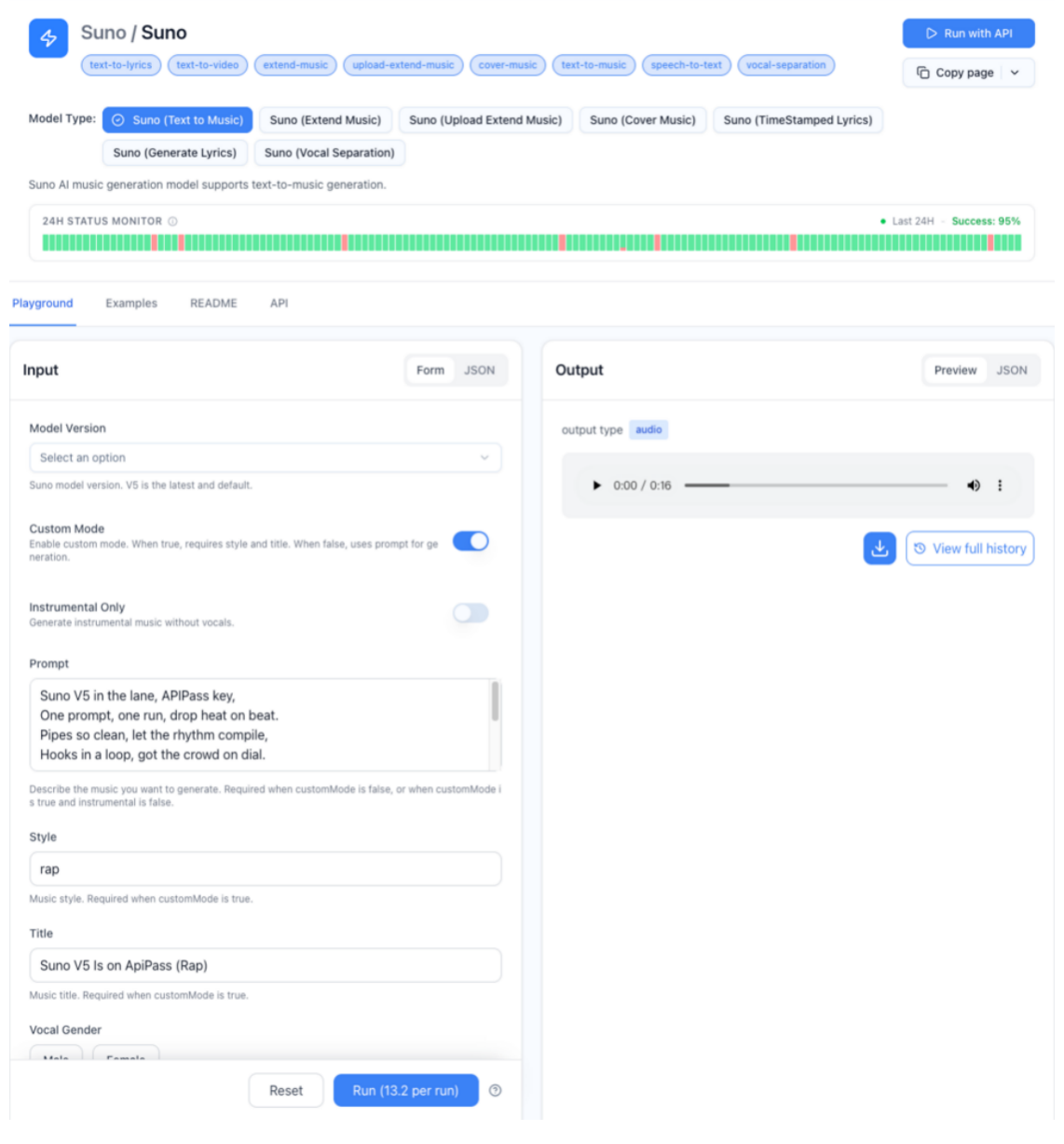
ApiPass exposes the most complete Suno rule set in this comparison — generate, extend, upload-and-extend, upload-and-cover, and vocal separation, all behind one unified async pattern. The Suno AI API on ApiPass treats completeness as a first-class concern: every rule is designed to return whole, structurally coherent musical outputs rather than truncated snippets, and the extension and upload-extend rules let developers stitch longer compositions from shorter generations without losing musical continuity. For teams building products where users expect a finished song — not a 30-second demo that fades mid-phrase — this end-to-end coverage matters far more than headline generation speed alone.

Features
- Full rule coverage: Suno Generate Music, Suno Extend Music, Suno Upload Extend Music, Suno Upload and Cover Audio, Suno Vocal Separation.
- Unified async submit-and-callback pattern across all five rules.
- Native extension support lets short generations grow into full-length tracks without reprompting.
- Upload-extend continues user-provided audio with model-generated continuation that preserves musical context.
- Upload-and-cover transforms uploaded audio into a Suno-rendered cover in the same flow.
- Vocal separation enables clean stems for remixing, karaoke, and downstream production.
- Webhook delivery with signed callbacks for downstream verification.
- Single API key and unified billing across the full Suno rule set.
Pros & Cons
Pros:
- Broadest Suno rule coverage of any platform in this comparison.
- Extension and upload-extend together natively solve the “finish the song” problem.
- Vocal separation enables advanced post-processing workflows in the same account.
- Consistent async pattern means no re-integration as you adopt new rules.
- Single billing relationship across the full lifecycle.
Cons:

- No typed SDKs yet — REST integration only.
- No granular per-rule scoping inside a single key.
Pricing
| Rule | Price per Run |
| Suno Generate Music | $0.060 |
| Suno Extend Music | $0.060 |
| Suno Upload Extend Music | $0.060 |
| Suno Upload and Cover Audio | $0.060 |
| Suno Vocal Separation | $0.050 |
Best For
Teams building music products that require the full song lifecycle — initial generation, extension to full length, covers from user-provided audio, and vocal stem extraction — all under one API and one billing relationship.
APIYI
Introduction
APIYI exposes Suno’s core generation and extension rules under its regional aggregator architecture, making it a strong fit for globally distributed music apps where regional response consistency matters as much as feature breadth.
Features
- Suno generate and extend rules with standard async ergonomics.
- Regional infrastructure with synchronized rollouts across geographies.
- Aggregated multi-model catalog under one account.
- Webhook delivery with standard signing.
- Unified billing across all integrated models.
Pros & Cons
Pros:
- Regional architecture supports geographically distributed user bases.
- Extension support enables full-length track workflows.
- Standard auth patterns ease integration.
- Multi-model catalog reduces vendor sprawl.
Cons:
- No native cover or vocal separation rules.
- Aggregator pattern means upstream dependencies during rollouts.
Pricing
Aggregator-credit pricing tracking upstream Suno rates per run.
Best For
Globally distributed music applications that need regional consistency and the core completeness primitives (generate + extend) under one aggregator account.
Kie
Introduction
Kie applies its lean catalog philosophy to Suno: it exposes the core generation and extension rules with minimal abstractions, making it well-suited for small teams that want full-track completeness without the operational overhead of a large platform.
Features
- Lean async REST with Suno generation and extension rules.
- Credit-based unified accounting.
- Transparent task states for clear monitoring.
- Standard webhook delivery.
- Predictable per-run pricing.
Pros & Cons
Pros:
- Minimal surface area accelerates time-to-integration.
- Extension support delivers full-length completeness for most use cases.
- Predictable platform behavior simplifies debugging.
- Lower operational overhead than larger aggregators.
Cons:
- No native cover or vocal separation rules.
- Smaller community for troubleshooting.
Pricing
Per-run credit pricing tracking core Suno rates.
Best For
Small teams and solo developers building music products that need full-track completeness without managing a wide multi-model catalog.
Together
Introduction
Together brings a curated approach to Suno completeness — generation and extension are exposed under the same security and observability discipline the platform applies to its LLM stack, appealing for teams consolidating multiple AI workloads.
Features
- Suno generate and extend rules under curated rollout discipline.
- Shared security model across LLM and music workloads.
- Org-level account structure with scoped keys.
- Hybrid sync and async API patterns.
- Configurable spend caps.
Pros & Cons
Pros:
- Curated rollouts reduce regression risk on completeness-critical rules.
- Shared stack with LLM workloads simplifies vendor consolidation.
- Org-level scoping fits team workflows.
- Mature observability tooling.
Cons:
- Narrower Suno rule breadth than ApiPass.
- Per-call cost higher than aggregator floors.
Pricing
Tiered per-run pricing within Together’s curated catalog.
Best For
Teams consolidating LLM and music workloads under one vendor who value curated, regression-tested completeness over maximum rule breadth.
BytePlus
Introduction
BytePlus brings enterprise-grade discipline to Suno integration. Generation and extension are exposed under documented SLAs, formal IAM, and procurement-friendly contracts — appealing for organizations where security and stability outrank raw feature breadth.
Features
- Suno generate and extend rules with enterprise SLAs.
- Token-pack subscription pricing with quota controls.
- IAM-style access controls and audit logging.
- Documented incident response and support channels.
- Official SDKs with documented auth patterns.
Pros & Cons
Pros:
- Enterprise vetting reduces production risk on completeness rules.
- Procurement-ready contracts and SLAs.
- Strong default concurrency for parallel music workloads.
- Formal IAM fits enterprise security posture.
Cons:
- Slower rule expansion than aggregator-fast platforms.
- Token-pack budgeting adds tracking overhead.
- No native cover or vocal separation rules.
Pricing
Tiered token-pack subscriptions converted to per-run cost.
Best For
Enterprise organizations that need Suno generation and extension under documented SLAs, formal IAM, and procurement-vetted contracts.
Apertis
Introduction
Apertis takes a workflow-oriented view of Suno completeness — its integration is designed so that generation and extension chain cleanly into downstream music workflows, with curated ergonomics suited to production pipelines.
Features
- Suno generate and extend rules with workflow-friendly ergonomics.
- Curated catalog with consistent integration patterns.
- Standard async REST with webhook delivery.
- Account-level spend caps.
- Unified billing across the catalog.
Pros & Cons
Pros:
- Workflow-oriented ergonomics streamline music pipelines.
- Curated rule exposure means production-vetted completeness.
- Consistent integration patterns across the catalog.
- Spend caps prevent runaway costs.
Cons:
- Narrower rule breadth than aggregators.
- Smaller community than top-tier platforms.
Pricing
Per-run pricing within Apertis’s curated catalog.
Best For
Teams building music workflows where Suno generation and extension are part of a longer creative pipeline that benefits from curated, workflow-oriented ergonomics.
OpenRouter
Introduction
OpenRouter’s routing-layer architecture treats Suno generation as one of many upstream backends, with automatic failover keeping music endpoints alive during upstream incidents. Completeness here means continuity of service across providers more than depth of rule coverage.
Features
- Multi-provider routing across Suno backends.
- Automatic failover during upstream incidents.
- Per-key budget caps as a first-class feature.
- Unified API surface across backends.
- Aggregated billing with per-key visibility.
Pros & Cons
Pros:
- Failover keeps generation endpoints available during upstream issues.
- Per-key spend caps enforce tight budget control.
- One integration covers multiple Suno backends.
- Strong operational reliability story.
Cons:
- Extension and advanced rules depend on the routed backend.
- Routing layer adds slight latency overhead.
Pricing
Pass-through pricing from upstream Suno providers, billed centrally with optional per-key caps.
Best For
Teams whose definition of completeness includes service-level reliability — keeping generation alive across upstream incidents — and who want per-key budget enforcement as a built-in feature.
Segmind
Introduction
Segmind brings its curated production-vetting discipline to Suno: generation is exposed with the same review process applied to the rest of its image and video catalog, making it appealing for teams that want vetted completeness rather than maximum rule breadth.
Features
- Curated Suno generation endpoint.
- Production-vetted catalog discipline.
- Standard async REST with webhook integration.
- Account-level spend caps.
- Consistent ergonomics across the broader catalog.
Pros & Cons
Pros:
- Curation filters out unstable builds.
- Production-vetted exposure simplifies QA work.
- Consistent ergonomics across image, video, and music.
- Mature platform tooling.
Cons:
- Narrower Suno rule coverage than aggregators.
- Slower to expose new rules than aggregator-fast platforms.
Pricing
Per-run pricing within Segmind’s curated catalog.
Best For
Production teams that prefer curated, vetted Suno generation alongside Segmind’s broader image and video catalog under one unified vendor relationship.
Piscart
Introduction
Piscart approaches Suno from a creator-tool angle — its integration emphasizes ergonomics that fit naturally into creative pipelines where music generation sits alongside image and video creation workflows.
Features
- Suno generation endpoint with creator-tool ergonomics.
- Standard async REST integration.
- Webhook delivery for async outputs.
- Integration patterns aligned with broader creative-tool workflows.
- Unified billing across creative workloads.
Pros & Cons
Pros:
- Creator-tool ergonomics fit naturally into multi-modal content pipelines.
- Consistent integration patterns across creative workloads.
- Suitable for teams already on the platform for image and video.
Cons:
- Narrower Suno rule coverage than aggregators.
- Less focused on music-specific completeness primitives.
Pricing
Per-run pricing within Piscart’s creative-tool catalog.
Best For
Creative-tool teams that already build with Piscart for image or video work and want Suno music generation under the same account and ergonomics.
NewportAI
Introduction
NewportAI rounds out the comparison with a credit-based completeness model: generation and extension are exposed under a unified credit accounting system with volume discounts that improve unit economics at scale.
Features
- Suno generate and extend rules under credit-based accounting.
- Volume credit packs with progressive discounts.
- Mid-breadth multi-model catalog.
- Standard async REST integration.
- Unified credit dashboard.
Pros & Cons
Pros:
- Extension support delivers full-length completeness.
- Volume discounts improve scale economics.
- Unified credit accounting simplifies multi-model integrations.
- Predictable per-run consumption.
Cons:
- No native cover or vocal separation rules.
- Credit-to-dollar conversion adds cognitive overhead.
Pricing
Credit-pack pricing with progressive volume discounts.
Best For
Teams that prioritize credit-based budgeting and progressive volume discounts while needing the core completeness primitives (generate + extend) under one account.
Final Thoughts: Matching Completeness to Product Shape
Music generation completeness isn’t a single ranking — it depends on what “complete” means for your product. A short-form ad-music app may only need a strong generation endpoint; a full-length music creation tool needs generation plus extension; a remix or karaoke product needs vocal separation; a user-audio-driven creator app needs upload-extend and cover. Each Suno API platform in this comparison has built its rule set around a distinct completeness philosophy:
- Full lifecycle (generate, extend, upload-extend, cover, vocal sep) → ApiPass
- Regional generate + extend → APIYI
- Lean generate + extend → Kie
- Curated LLM + music stack → Together
- Enterprise-vetted generate + extend → BytePlus
- Workflow-oriented generate + extend → Apertis
- Multi-backend routing reliability → OpenRouter
- Curated production-vetted generation → Segmind
- Creator-tool integrated generation → Piscart
- Credit-economics generate + extend → NewportAI
Pick the platform whose completeness philosophy matches the song lifecycle your product needs to deliver — and the difference between “users got a snippet” and “users got a finished song” becomes an architectural choice rather than a recurring frustration.

